

Understanding the += Operator in Java and Its Applications
In the realm of programming, understanding the various operators is fundamental to writing efficient and concise code. Among the many operators that Java offers, the `+=` operator holds a special place. This operator might seem puzzling to newcomers, but it’s an essential tool for manipulating variables and performing shorthand operations. In this article, we will delve into the world of the `+=` operator, exploring its functionality, use cases, and advantages.
What is the `+=` Operator?
The `+=` operator is known as the addition assignment operator in Java. It combines the addition operator (`+`) with the assignment operator (`=`). Essentially, it allows you to update the value of a variable by adding another value to it. This operator provides a concise and elegant way to modify variables without needing to rewrite the variable name.
Usage of the `+=` Operator
The basic syntax of the `+=` operator is `variable += expression;`. Here, `variable` is the variable whose value you want to update, and `expression` is the value that you want to add to the variable. Let’s look at a simple example:
“`java
int count = 10;
count += 5;
“`
In this example, the `count` variable is incremented by 5 using the `+=` operator. The result is that `count` now holds the value 15.
Benefits of Using the `+=` Operator
- Concise Code: The `+=` operator allows you to update variables in a single line of code. This concise syntax can enhance the readability of your code and reduce the chances of errors.
- Enhanced Maintainability: The `+=` operator can lead to improved code maintainability by reducing the need for redundant variable assignments. When updating variables in a loop or iterative construct, using the `+=` operator keeps the purpose of the code clearer by encapsulating the update operation within the loop body. This makes the code more self-contained and easier to maintain, as future modifications or updates to the loop logic won’t require separate assignment statements.
- Floating-Point Precision: When working with floating-point numbers, be cautious of rounding errors. Due to the nature of floating-point arithmetic, using the `+=` operator for accumulating small values might result in unexpected precision issues.
- Overuse: While the `+=` operator can enhance code readability, excessive use of compound assignment operators in complex expressions might make your code harder to comprehend. In such cases, opting for traditional assignment and arithmetic operators might be more advisable.
Best Practices for Using the `+=` Operator
To make the most of the `+=` operator and ensure clean, maintainable code, consider the following best practices:
- Choose Descriptive Variable Names: Use variable names that convey their purpose clearly. This makes your code more understandable and reduces the chances of errors caused by ambiguous variable names;
- Avoid Chaining: While the `+=` operator allows chaining multiple operations, it’s recommended to keep operations separate for clarity. Complex chains of compound assignments can confuse other developers reading your code;
- Use Comments: If your code involves intricate operations or if you’re concerned about code readability, consider using comments to explain the purpose of the `+=` operation;
- Check Compatibility: Always ensure that the data types of the variable and the expression being added are compatible. Mismatched types can lead to unexpected behavior;
- Keep Precision in Mind: If you’re working with floating-point numbers, be mindful of precision issues. In scenarios requiring high precision, consider alternative approaches.
Examples of `+=` Operator Usage
The += is an addition assignment operator. It adds the value of the right operand to the variable and assigns the result to the variable. It is equivalent to i= i+n.
Let us consider a variable i. The operationi+=n is equal to i=i+n, where n is a constant value and the value of i varies.
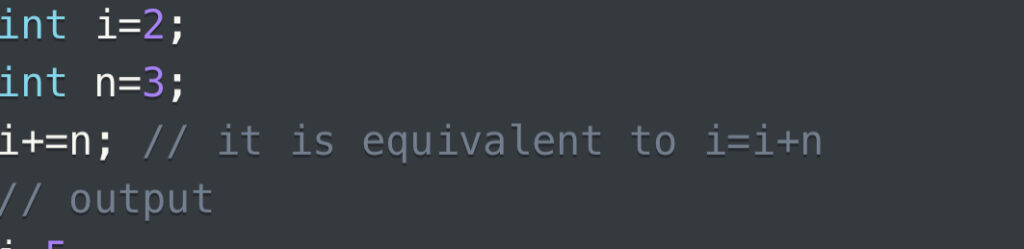
The operations i++ and i+=1 do the same task of incrementing the value of i by 1. In fact, i+=1 is a shorthand notation of i++.
The difference between i++ and i+= is that i++ is restricted to increment the value of i by 1, whereas i+= can be used to increment i value by any numeric value like i+=2, i+=200, i+=300,… and so on.
In the operation i+=n the data types of n and i should be the same.
The below example illustrates the use of += operator. In the program, initially the value of a=10. After the operation a+=n evaluates a=a+n=10+4, hence value of a = 14.
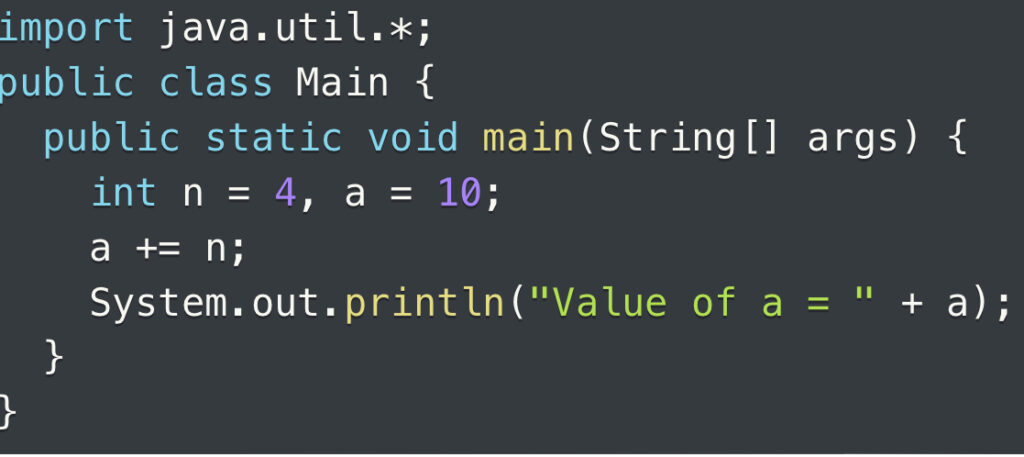
The output is:
Value of a = 14
Assignment operator for String data type
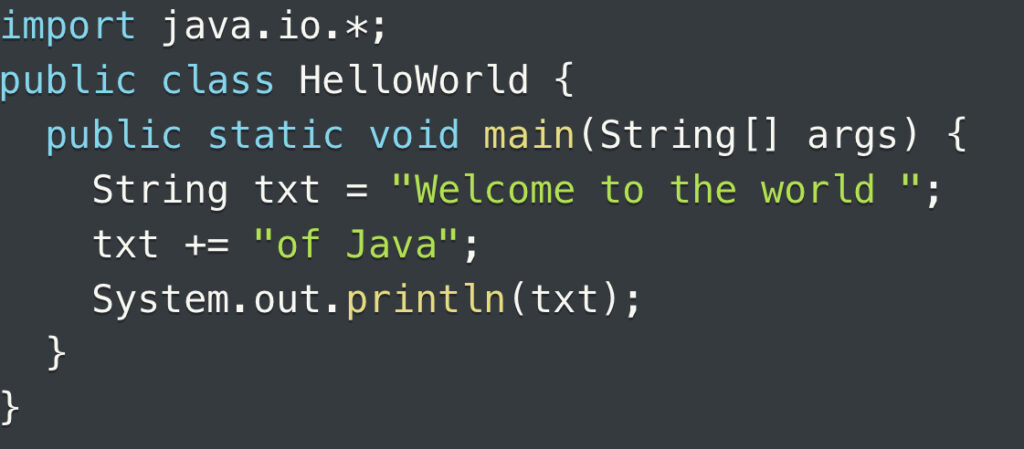
In Strings, the operator += can be used to concatenate two strings.
The example below illustrates the concatenation of strings using += operator.

Alt: Java code.
The output is as follows:
Welcome to the world of Java
Assignment operator for float data type
The float data type is when the user needs to carry some operations with decimal numbers. The addition assignment operator can be used to add a floating-point value to a variable. In the operation i+=x.y, x.y is the floating-point value and remains constant.
The example below illustrates the operation of the += operator over floating-point values. Here b = 8.2 is added to c which is 1.8.
The output:
10.0
Assignment operator for double data type
The double data type is generally used for decimal values just like float. The assignment operator can be used to add two double numbers. The operation of the operator i+=m.nx is the same as in float data type. The value of m.nx remains constant while the value of i varies.
Let us consider an example of adding a double data type.
Output:
Result=600.01
Assignment operator for short data type
The short data type can be used to save memory. The addition assignment operator can also be used in the addition operation of short data types. Let us consider k+=n, where k and n should be short data types and n is a constant short value.
Example program
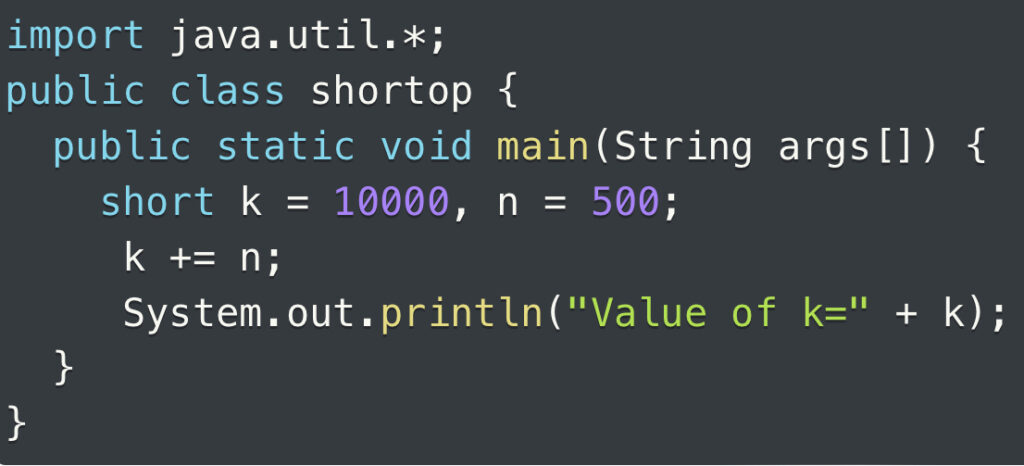
The output:
Value of k=10500
Assignment operator for long data type
The long data type is used when the user requires a range of values that is more than those provided by int. The assignment operator can be used for the operations of long data types. In the addition assignment operator p+=q, where p and q are both long data types, p and q should be a long data type variable.
An example illustrates the use of assignment operator with long data types
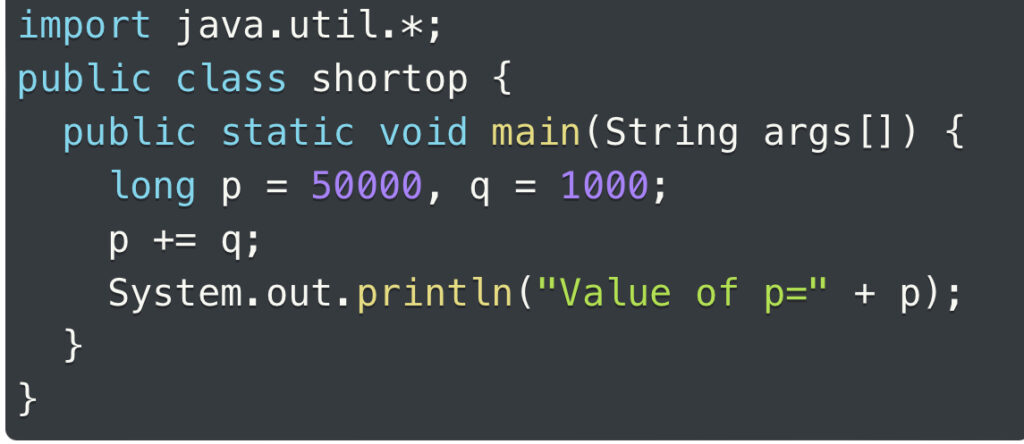
The output is:
Value of p=51000
To wrap up
In conclusion, the `+=` operator in Java proves to be a powerful tool for performing efficient incremental updates on variables. It combines the addition and assignment operators, allowing for concise and elegant code that enhances readability. While its benefits include conciseness and reduction of errors, it’s important to be aware of potential precision issues, particularly when working with floating-point numbers. Best practices for using the `+=` operator involve choosing descriptive variable names, avoiding excessive chaining, using comments for clarity, ensuring data type compatibility, and considering precision requirements. The operator finds application across various data types, from integers and floats to strings and longs. While offering convenience and succinctness, its usage should be tempered by thoughtful coding practices to maintain the clarity and maintainability of the codebase. By mastering the `+=` operator and adhering to best practices, developers can harness its efficiency and elegance for more effective Java programming.