

How to Harnessing Mockito Verify: Ensuring Method Accuracy
In the realm of Java unit testing, precision in method invocations holds paramount significance. Within this domain, the widely-utilized mocking framework, Mockito, emerges as a beacon of efficient testing practices. One of its stalwart tools, the “verify” feature, empowers developers to engage in meticulous validation of specific method executions during testing endeavors.
This comprehensive guide embarks on a journey that plunges deep into the intricacies of Mockito’s verify functionality.
Here, the spotlight shines brightly on its manifold applications, intricate syntax, and real-world deployment scenarios. By the culmination of this expedition, you will have acquired the adeptness required to wield Mockito verify with the dexterity of a seasoned testing professional.
The Vigilant Observer
At the core of Mockito’s arsenal, the verify feature serves as a vigilant observer, meticulously inspecting the orchestration of method invocations during the course of testing. This process unfurls a tapestry of interactions between the system under examination and its interdependent components. The resultant validation offers a reassuring avenue to confirm that the expected behaviors indeed unfold precisely as they were intended.
Advancing Toward Expertise: Refining Your Method Validation Craft
As the guide unfolds, your voyage through the intricacies of Mockito verify transitions from a beginner’s initiation to an expert’s refinement. The previously traversed terrain has already unveiled the essential concepts; now, let’s explore advanced techniques that elevate your mastery of Mockito verify to new heights.
Learn more about how to use verify in Mockito in the next tutorial
Harnessing Conditional Verification
In the realm of method validation, the ability to employ conditional verification is a hallmark of testing maturity. Mockito verify can be coupled with Mockito.times() to ascertain that a method was invoked a specific number of times within a test scenario. This nuanced approach is instrumental in situations where repeated or selective method calls are of consequence:
// Simulating a mock object
InventoryManager inventoryManager = Mockito.mock(InventoryManager.class);
// Executing inventory update
inventoryManager.updateStock(5);
// Verifying method invoked thrice
Mockito.verify(inventoryManager, Mockito.times(3)).updateStock(Mockito.anyInt());
Method Invocation Verification
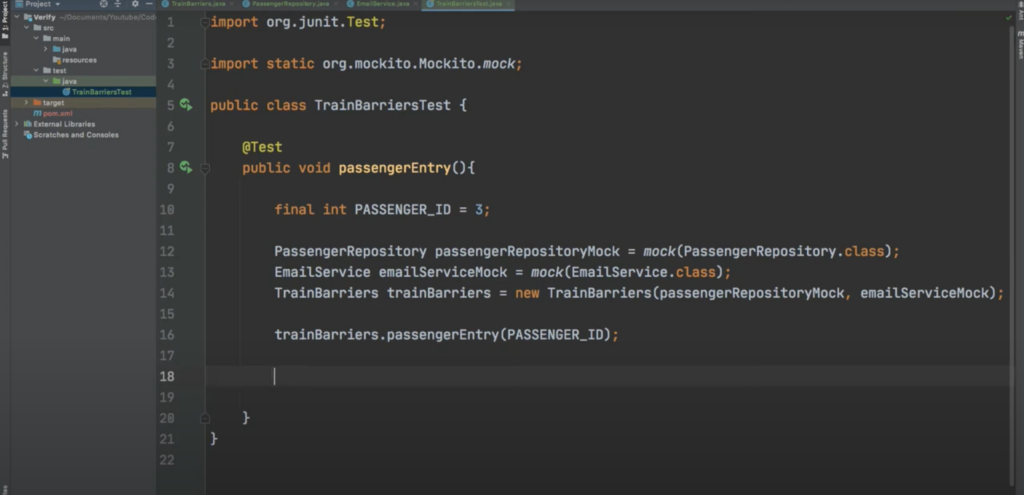
Harnessing the power of Mockito verify commences with the creation of a mock object, an embodiment of the desired class. For instance, consider a scenario where the service method “performAction()” resides within the ambit of the “MyService” class. By employing Mockito’s verify method, one can ensure the execution of the targeted method:
// Craft a mock object
MyService myService = Mockito.mock(MyService.class);
// Execute the method under scrutiny
myService.performAction();
// Verify the method’s invocation
Mockito.verify(myService).performAction();
Verifying the Absence of Method Invocation
Diving further into the capabilities of Mockito verify, it also extends its gaze towards the validation of the absence of method calls. Imagine a circumstance where the objective is to ascertain that a specific method, say “cancelAction()”, remains dormant during a designated test case:
// Assemble a mock object
MyService myService = Mockito.mock(MyService.class);
// Verify the method’s absence
Mockito.verify(myService, Mockito.never()).cancelAction();
Constructing Test Suite Integrity
The true essence of Mockito verify lies in its role as a cornerstone for cultivating robust test suites. Through the validation of method invocations, the tapestry of anticipated interactions between distinct components is woven. This function takes on the mantle of a safety net, steadfastly warding off potential regressions and nurturing code stability throughout the evolutionary journey of your project.
Illustrating with a Real-Life Application
Consider, for instance, a financial institution’s application housing a class known as “TransactionManager” working in tandem with a “PaymentGateway”. Through the employment of Mockito verify, the assurance of a seamless initiation of a payment transaction becomes attainable:
// Forge mock objects
TransactionManager transactionManager = Mockito.mock(TransactionManager.class);
PaymentGateway paymentGateway = Mockito.mock(PaymentGateway.class);
// Initiate the payment transaction
transactionManager.processPayment(paymentGateway);
// Verify the commencement of payment
Mockito.verify(paymentGateway).initiatePayment(Mockito.anyDouble());
Conclusion
Mastery over the art of Mockito verifies serves as a beacon, illuminating the path to heightened proficiency in unit testing. The microscopic lens it offers into the interactions between components is a potent asset. By endorsing the validation of method invocations and embracing their deliberate absence, a robust foundation for testing is cemented, elevating the quality and fortifying the stability of the codebase.
As your journey in Java development unfolds, remember that Mockito verify is not a mere feature; it emerges as a steadfast companion, steadfastly supporting your quest for code that stands as a testament to trustworthiness and freedom from defects.
With a newfound mastery over Mockito verify, the orchestration of precise and dependable testing unfolds, underscoring the essential role of Mockito in fortifying the foundations of quality code.