

/= in Java: A Journey Through Division Assignment
In the vast realm of Java programming, operators emerge as the foundational tools that empower developers to manipulate data and perform a plethora of computations. Among these operators, the `/=` operator stands out as a formidable asset, known for its prowess in division assignment. This guide embarks on a captivating journey to decode the `/=` operator in Java, unraveling its intricate purpose, syntax, and real-world applications.
As you delve deeper into this exploration, you’ll gain a comprehensive grasp of how to wield the `/=` operator effectively, augmenting your prowess in the world of Java programming.
Understanding the Division Assignment Operator
In the Java lexicon, the `/=` operator is recognized as the division assignment operator. It seamlessly marries the concept of division with the notion of assignment. This unique fusion allows developers to execute division operations on a variable and promptly store the resultant value back into the variable. Essentially, the `/=` operator is a succinct strategy for performing division while concurrently updating the variable’s value.
Dissecting the Syntax
The syntax of the `/=` operator exudes simplicity. It adopts the form `variable /= value;`, where `variable` embodies the variable under division and update, and `value` represents the divisor. The outcome of the division seamlessly integrates with the variable, assuring a seamless flow of data manipulation.
Unveiling the Ubiquitous `/=` Operator in Java
The answer is affirmative— the `/=` operator is a legitimate participant in the realm of Java programming. This operator emerges as a trusted ally, streamlining division operations and assignments. Its prowess shines brightly when faced with scenarios that involve division by specific values, all while facilitating efficient storage of results devoid of verbose assignment statements.
Real-World Scenarios for the `/=` Operator
Imagine you are crafting a dynamic financial application tasked with calculating accrued interest over time. Enter the `/=` operator as a loyal companion; it allows you to gracefully adjust the investment amount based on the prevailing interest rate:
double investment = 1000.0;
double interestRate = 0.05;
// Utilizing the /=
investment *= (1 + interestRate);
System.out.println(“Updated investment: ” + investment);
Decoding `num /= 10`
In the enigmatic landscape of Java, the expression `num /= 10` signifies an intriguing operation. It involves dividing the value of the variable `num` by 10, followed by the transmission of the outcome to `num`. This operation finds common ground in its capacity to truncate or eradicate the last digit of an integer, crafting a versatile tool in the developer’s toolkit.
Find more meanings of Java operators in this video
Embarking on a Real-Life Application
Imagine you’re steering the ship of a program designed to metamorphose decimal numbers into their binary counterparts. To achieve this feat, you must repeatedly divide the number by 2, meticulously recording the remainders. The `/=` operator emerges as a trusted ally, simplifying this intricate dance of transformation:
int decimalNumber = 23;
String binaryRepresentation = “”;
while (decimalNumber > 0) {
int remainder = decimalNumber % 2;
binaryRepresentation = remainder + binaryRepresentation;
decimalNumber /= 2; // Engaging the /= operator
}
System.out.println(“Binary representation: ” + binaryRepresentation);
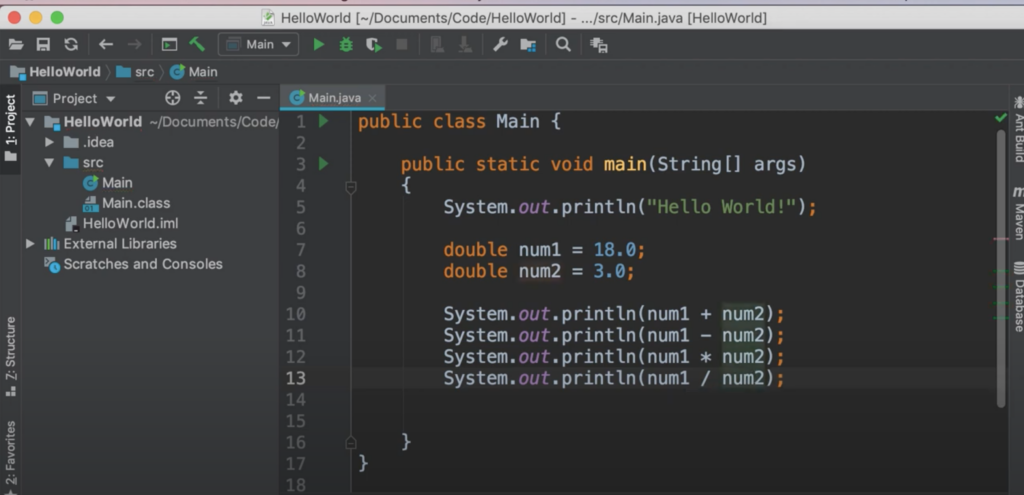
Expanding Horizons: Beyond Division with Compound Assignment Operators
While the `/=` operator dazzles as a division assignment maestro, it’s imperative to recognize that it is merely one gem among a treasure trove of compound assignment operators within Java. These operators weave together arithmetic operations with assignments, unfurling a tapestry of succinctness and efficiency. A glimpse into these operators paints a vivid picture of their capabilities:
The += Operator: A Dance of Addition
The `+=` operator choreographs the art of addition and assignment in a single harmonious move. It unites the right-hand operand with the left-hand operand, with the result finding its dwelling in the left-hand operand.
Behold it in action:
int x = 5;
x += 3; // Equivalent to x = x + 3;
System.out.println(x); // Output: 8
The -= Operator: A Symphony of Subtraction
Mirroring the elegance of a symphony, the `-=` operator orchestrates the realm of subtraction and assignment. It subtracts the right-hand operand from the left, endowing the left-hand operand with the fruits of its labor:
int y = 10;
y -= 4; // Equivalent to y = y – 4;
System.out.println(y); // Output: 6
The *= Operator: Multiplying the Magic
The `*=` operator exudes an aura of multiplication and assignment. It multiplies the left-hand operand by the right, bequeathing the outcome to the left-hand operand’s realm:
int z = 3;
z *= 5; // Equivalent to z = z * 5;
System.out.println(z); // Output: 15
The %= Operator: Embracing the Remainder
Intricately attuned to the concept of modulus operation and assignment, the `%=` operator calculates the residue of dividing the left-hand operand by the right, offering this remainder to the left-hand operand’s sanctuary:
int a = 17;
a %= 5; // Equivalent to a = a % 5;
System.out.println(a); // Output: 2
Find more meanings of java operators in this video
Conclusion
In your relentless pursuit of Java programming excellence, you are bound to unearth an array of operators that orchestrate intricate operations with finesse. The `/=` operator, joined by its compound assignment peers, bears witness to Java’s dedication to efficiency and code readability.
By embracing these operators, you are not only streamlining your code but also showcasing your adeptness in leveraging the language’s arsenal to its fullest. Whether division, addition, subtraction, multiplication, or modulation, compound assignment operators await your command to craft elegant and efficient code.
As you continue to nurture your skills, always bear in mind that these operators hold the key to ushering in cleaner, more expressive, and infinitely more maintainable code. Armed with this newfound wisdom, you stand poised to weave Java applications that transcend mere functionality, emerging as a delightful symphony for both developers and users.